Sunday, November 15, 2015

More Than A Gesture Of Kindness

Robin Sutherland with the note Officer Catato sent.
There are some days when it can all seem to go wrong. Robin Sutherland was having one of those days. She had just learned that day that her 90-year-old mother was entering hospice care, her last parent who was still alive. It was one of those things, that besides being heartbreaking, has life-changing implications.

To top it off, this Somerville, Massachusetts, woman happened to be driving down a street that had a posted speed limit of 30 MPH, only she was doing 40. Then, to top it off, a police officer noticed and she was pulled over. It was something that on other days she never does, but the one day when she was so upset and not paying attention, she was stopped. It was too much to bear, and the tears flowed. Robin said, about the moment, "I just realized when we lose my mother I'm the older generation now and it just hit me."


However, Officer Ashley Catato, who had stopped Ms. Sutherland, wasn't without a heart. Instead of a ticket, she issued this driver a warning, while she comforted her, then sent her on her way. It's not all police officers who would have done that. But it was what happened next that captured Robin's heart.

That evening, there was a surprise awaiting the Sutherland family. Officer Sutherland had sent the family, and the woman she stopped, a big bouquet of flowers, along with a note. The note read, "I'm very sorry about your mother. I hope you find comfort in knowing she lived a long life and will continue to live on in your heart and memories. [Signed by] Officer who pulled you over this morning." What a very nice gesture to help out a family going through a rough time!

Officer Cantato's actions did not go unnoticed. Both the Mayor of Somerville and the Deputy Chief of Police honored their Officer with a heart of gold. As for Officer Cantato, she feels that what she did was nothing out of the ordinary, "We do things like this all the time. It just doesn't get much notice in the press. I was just doing what I know most people would have done anyways. It just seemed so natural for me."

Robin Sutherland with the bouquet and flowers sent by Officer Catato.
But for Ms. Sutherland, the act was no ordinary gesture, It had great meaning for her. She said, "For her to go out of her way for someone who was having kind of a tough day, it was just amazing."

Everyone has had very bad days, similar to what Ms. Sutherland experienced. Wouldn't it be nice for our fellow human beings to notice and do something nice? It doesn't have to be flowers, just a listening ear will help - and that doesn't cost any money, either.

One of Boston's finest, Officer Ashley Catato.
Thanks to this article from Good News Network: http://www.goodnewsnetwork.org/officer-sends-flowers-crying-woman-pulled-speeding/; and this article from CBS Boston: http://boston.cbslocal.com/2015/11/05/somerville-officer-sends-flowers-note-to-woman-she-pulled-over/.


Saturday, November 14, 2015

Maintaining Food Crop Diversity

One of Cleveland Seed Bank's publications.
It all started with a trip to India in 2010 by Chris Kennedy, a school teacher, and his wife, Marilyn McHugh, a biologist. They met Dr. Vandana Shiva, who was helping local farmers learn organic techniques through her organization, Navdanya. That organization had established more than 110 seed banks throughout India.

At the same time, the couple's home city of Cleveland was experiencing a growth of urban farms and markets, feeding a local food movement. With the idea of seed banks, like the ones in India, in mind, this twosome traveled to the sites of several seed bank initiatives to learn from them.


By 2013, the CLEVELAND SEED BANK became a reality, after both Marilyn and Chris developed a collaborative arrangement with the Cleveland Public Library to place seed libraries in five library branches. These branches function as in-person venues for seed exchanges.

At the time, Christopher said, "[We] seek to empower at least 100 individuals to join our network, learn seed saving techniques, and participate by saving their own seeds and accessing the local varieties saved by others." That led to a search for a way for their website to allow users to trade seeds with each other.

At the time, there was no developed online engine to allow the development of a members area where participants could trade or share their seeds. However, the seed bank had as a member a local hacktivist, Meitar Moskovitz, who was already a team member. He wrote the code that developed an open-source WordPress plug-in that provided the desired functionality. That plug-in is now available in three different languages. Today, the seed bank has over 200 members and has more than 700 seeds posted for exchange.

Why go through all of this to maintain a supply of seeds? With the proliferation of factory farms, much biodiversity has been lost. When food banks are established and utilized by smaller growers, it enhances genetic variability. That provides a certain amount of safety when a disease attacks crops with a certain genetic make-up, since seeds that are just a bit different genetically could survive an onslaught by that same disease. In essence, it makes crops more vigorous and less vulnerable.

Workshop held last month on seed saving.
Although this isn't a pitch for more seed banks, that really isn't a bad idea. The more seed banks that are developed, the more biodiversity is preserved. That keeps food crops more secure and vigorous. And that doesn't even include the fact that fresh fruits and vegetables are needed for good nutrition and help fill in urban areas which have become food deserts. So, support your local food bank. If you have time and energy and your area lacks one, by all means, use your talents to develop one. That's all win-win!

A social event that helps to spread the word about Cleveland Seed Bank.
Thanks to this article from Pollination Project: https://thepollinationproject.org/grants-awarded/christopher-kennedy-cleveland-seed-bank/.


Thursday, November 12, 2015

What Is Reasonable Pre-Natal And Birth Care?

Johns Hopkins Bloomberg School of Public Health, 100 years old next year.
I bet that if most of you were asked, you would probably say that the amount of care provided to pregnant women in this country would lead to a relatively low infant mortality rate. But you would be wrong. Despite increasingly higher costs for pregnancy and maternity health care, the rate of infant deaths remains relatively high, so high, in fact, that it matches the rate in Iran. There has been no statistical progress in reducing infant mortality rates since 2009.

Why? Gerard Anderson, who is the director of the CENTER FOR HOSPITAL FINANCE AND MANAGEMENT AT JOHNS HOPKINS, part of Johns Hopkins Bloomberg School of Public Health, based in the Baltimore area, where I live, believes that today's health care system is designed for women who are well-insured and part of a high-earning family. In this world of wealth, most patients are assumed to want only two children at most, want the very best amenities and cutting-edge care, and are willing to fill in the gaps if insurance doesn't cover it. So the assumption, according to Mr. Anderson, is "We're not having very many babies, so we want it to be a really pleasant experience."


So, what happens elsewhere? Say, in Denmark, the government picks up the costs, but the care is much less personalized, with patients doing such things as receiving fewer tests and procedures and carrying their paperwork from department to department. In China, pre-natal care is routinized, not customized, so it is more cost effective, but it maintains healthy care. If a woman needs a c-section, that costs around $1,000. Most patients bring their own helpers for hospital care. In the US, though, C-sections cost a whopping $50,000; both insurance and patients share the costs in some manner.

Costs can vary here in the US, dependent on where a person lives. Even when a woman has insurance, a patient's share of the costs varies by plan, depending on the deductible amount and percentages that patients are asked to co-pay. That doesn't even count the little amenities that are offered, but not covered by insurance. In a study of five different States, it was found that Louisiana provided the lowest cost vaginal birth at $10,318 and the highest cost of C-sections came from California at $21,307 in 2013.

Not a single State has managed to figure out how to limit costs to the same extent as what is charged in the rest of the developed world. As long as expectant parents expect all of the luxuries, tests, and fancy equipment that they do today for their best feel-good experience, none of that will change. As Mr. Anderson maintains, "In many cases, [patients] do have a very good personal experience, until they see the bill."

Twitter chat with Dr. Josh Sharfstein, Dr. Shelley Hearne, and  Dr. Leana Wen.
So, as a people, we must consider how important all of these extras are to the care we receive. It's obviously not affecting the quality of the health of a newborn, as evidenced by the higher mortality rates. Shouldn't we be focusing more upon how to make sure that infants survive and flourish in the best way possible, in a way that we can all afford? Surely, it isn't that difficult to carry your own papers to another department, or for a family member to refill your water pitcher. Let's be sensible, find out what evidence shows is the proper care, and fund that for everyone.

Mother and child in Pakistan.
Thanks to this article from The Atlantic: http://www.theatlantic.com/business/archive/2015/11/americas-pregnancy-care-paradox-paying-ever-more-for-the-same-bad-results/415032/


Click here: WORK AT HOME JOBS

Wednesday, November 11, 2015

Amber Alert Saves A Kidnapped Child

Brooklynne Enix, with some pumpkins.
One woman dead and her child missing - that could be a headline from just about anywhere. This particular tragedy happened in Knoxville, TN, leaving a mother of three girls dead. Kimberly Enix, the mother, who was also a social worker specializing in domestic violence, had a very giving heart. But all of that wasn't enough to keep Kimberly from become abused herself.

The grandmother who raised her, Dorothy Graham remembers, "I saw the bruises on her arms and shoulders. He threatened to kill her twice." An aunt, Cheryl Kemp, who was raised in the same home with Kimberly, said, "She did get out of the situation, once she realized how bad of a situation it was." By April of this year, her divorce with her ex-husband was finalized, but even that was not enough to remove him from her life. According to Cheryl, "She did try her best to keep her and her daughter safe. Unfortunately, it wasn't enough, and here we are."


Here we are is rather gruesome. Failure to show up at work caused co-workers to alert police to perform a welfare check. They found Kimberly Enix dead and her daughter Brooklynne, age two, missing. Through investigation, police identified Kimberly's ex-husband as the alleged killer and the abductor of their daughter. That's when the amber alert was issued.

Enter war veteran Stephen Adams, two states over, in Morrow County, Ohio. Mr. Adams had been on the road to make a doctor's appointment that he hadn't realized had been cancelled. So he ended up on the same road that the abductor was travelling with the cute little girl in the back seat. There she was, a bubbly toddler, waving at Mr. Adams. There was something about that car... Maybe it was the one the police were trying to find; it did have Tennessee plates.

So, Mr. Adams called 911, even though he couldn't quite see all of the digits on the plate. So, he offered to pull closer and read the numbers off. That was the one! He kept following the car, reporting its location until police could catch up and stop that car's driver. It ended with the arrest of the man/father who had abducted young Brooklynne and the young toddler in the safe care of Ohio's Department of Children's Services, completely safe and uninjured. Arrangements are being made between Ohio and Tennessee for Brooklynne's return to her home state. Two older sisters, Alexia, 15, and Olivia, 11, along with their father, Chris Morrison, are awaiting her return and hoping to add her to their family.

Daughters Alexia and Olivia Morrison carry candles in memory of mother, Kimberly Enix.
As for Mr. Adams, the man in the right place at the right time, Knoxville police are reporting that they plan to give him an award of $1,000 for his actions. However, Mr. Adams, quite taken with the waving little girl whom he saved, plans to give that money back to Brooklynne. Although a quite beautiful mother lost her life, some people who never knew her family gave back the gift of a little girl, who can now look forward to growing up with the comfort of remaining family members and a supportive community.

Veteran Stephen Adams, whose sharp eyes aided police.
Thanks to this article from WBIR.com: http://www.wbir.com/story/news/local/2015/10/30/enix-waives-extradition-victims-family-mourns/74879688/; and this article from WRCBtv.com: http://www.wrcbtv.com/story/30376934/kpd-toddler-kidnapped-from-condo-where-woman-was-found-dead.

Click here to visit Contextures Inc.. Then look for Data Valuation Multi Select Premium Kit.


Saturday, November 7, 2015

Artist/Host Exchanges

Some of the art works available at a recent fund-raiser.
What do you do if you're an artist and need that special place where you can create and express yourself? What if you're a home owner with some extra space? Say, if you're also part of an organization that is interested in having a workshop for teenagers interested in a specific medium?

Can these problems be solve? They can be if today's technology can provide an appropriate platform. LYDIA PARR, an artist herself, who lives in Flagstaff, AZ, came up with that solution. An online solution, it is a platform, known as NOMAD INTERNATIONAL ARTS RESIDENCY EXCHANGES, on which artists in search of artistic spaces can post what their skills and talents are and specify a geographic location in which they are interested by creating a profile. They can also present what they will provide their host in exchange for the space.


Those who have available room in a building or home can specify what is available and seek out specific types of artists. When they have a match, they can then make arrangements to formalize the deal. It's based on trade and crowd-sourcing. Artists receive a new location and space, where they don't have to worry about hotel fees, competing for arts residencies, or even fees to have you and your work considered. It's also away for artists who are just starting out to build up their resume of projects and works. The person with the space gains a learning experience, a workshop, lessons, a work of art, whatever the artist was willing to provide. That person can also observe the creative process, watching a creative piece emerge and then be completed.

The website does say that the site is still in beta testing. That means it's up and running. but it's also being revised on the fly, based on how people use it, what glitches are encountered, and the feedback provided by users. Artists can register and search by locations, after registering, and can also present their artistic genre, background, and desires for artistic space. Those with space available can search artists by medium, location desired, and services offered.

Artistic jewelry at an event to raise funds for the exchange.
In the end, "the goal is to foster the connection between people around creativity in ways that are fun and mutually beneficial." Who knew that as the internet evolved, it could provide this type of connectivity between artists and sponsors, who don't even have to be wealthy in order to have a one-to-one connection with an artist.

Feedback by one of the website users.
Thanks to this article from Pollination Project: https://thepollinationproject.org/grants-awarded/lydia-paar-nomad-network-mutual-artistic-development/


Friday, November 6, 2015

Out Of Tragedy Comes A Greater Good

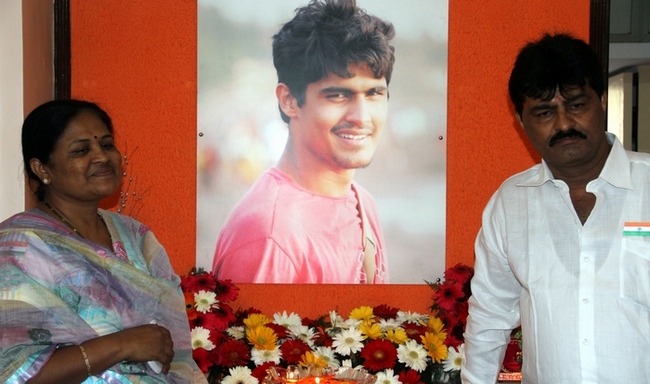
Two loving parents with the son they lost.
No parent ever wants this to happen - losing a child. Most of those on this earth expect that their end will come before that of a child, that they won't end up burying a beloved child. That was true for Pradeep and Damyanti Tanna, who live in Mulund, India.

The couple had only one child, Nimesh, who was 22, and a photographer. One fateful day in August 2011, Nimesh took a crowded train to a meeting scheduled in Mumbai. But, although he got on the train, he never got off, and he never made that meeting. At the exact moment that he put his head out of the window, it made contact with a pole too close to the tracks. He was thrown from the train and died instantly. That one moment was devastating for his parents.


According to Kintan Parekh, a close friend of Nimesh, "I was with his parents at the time they got the call....His father was a heart patient so I didn't tell him exactly what had happened.,,,But when we reached the accident site, his father broke down. He couldn't believe what had happened. It was such a tough thing to accept for everyone....He was a well-known boy and everyone loved him."

But that wasn't the couple's only loss. Not long afterwards, Pradeep lost his sweet shop after it was found out that his partners had cheated him from some of the profits. That's when Kintan stepped in and helped his friend's family. Kintan and Pradeep became partners when they opened a new sweet shop in the same town.

Once it became obvious that the business was providing sufficient income, Pradeep and Damyanti made an important decision about how to honor the memory of their departed son. Kintan reports, "Nimesh was always socially inclined. He would help people in need, donate money, do volunteer work - he was very compassionate. His parents thought that starting an NGO under his name would be the perfect way to pay a tribute to their son." So, on January 26, 2013, both parents established and registered the SHRI NIMESH TANNA CHARITABLE TRUST (SNTCT).

Once in operation, the couple started by cooking food in their small kitchen for thirty people. That grew to providing lunches for 100 of Mumbai's underprivileged families. For more than two years, every single day, without a day off, the meals are made. The family now has a bigger kitchen close to their home and seven staff members to help with the meals. At first, Kintan and his uncle would help to deliver the meals, but that got difficult as business matters took up more of their time.

Now, SNTCT has started working with some of the tribal groups in Mumbai, providing them with meal kits, all of the ingredients for meals for an entire month, since these groups are so marginalized by society that they don't have much access to work opportunities. The charity also has a Kids' Bank, with such needed items as clothing, toys, books, bicycles, etc.; and a separate initiative provides needed medications to seniors.

The tiffins loaded with meals are awaiting delivery.
As Kintan says, "There couldn't be a better tribute to Nimesh. He was a person with a golden heart and we are trying to keep him alive through the Trust." What a wonderful way to commemorate the spirit of a decease family member, with a living legacy that maintains a lifeline for many families in need!

A worker prepares the food that goes into daily tiffins for families in need.
Thanks to this article from The Better India: http://www.thebetterindia.com/35206/shri-nimesh-tanna-charitable-trust-tiffin-service-mumbai/.


Click here: HOW TO DOUBLE YOUR SALES FOLLOW-UP MARKETING

Wednesday, November 4, 2015

Fair Trade In The Ruwenzori Region, Uganda

Joseph Mbusa in front of his home, built with fair trade vanilla funds.
There is something different about fair trade products, compared to the usual type of trade between nations. Many times regular trade involves someone in the middle siphoning off profits, or a factory farm, which may employ locals or immigrants via labor brokers, providing shabby living and working conditions.

Fair trade, on the other hand, utilizes goods raised or made by local producers, with all of the funds being divided among the producers. Sometimes, there are local associations that share profits and supplies, such as the Mubuku Vanilla Farmers Association (MVFA), which has about 1,000 members who provide farm products from the Ruwenzori region of Uganda. Some of the highest quality vanilla is grown in that area, with a total of 16 metric tons of fair trade vanilla provided internationally every year. The association also embraces fourteen vanilla farming cooperatives.


Although fair trade and the MVFA offer ways to market local farm products, many of the families remain at the poverty level and very few children have access to education. So, such market factors as reduced prices for their vanilla affect the quality of life. Even with a growing population of children, the number of schools available have not kept up with demand.

Under the chairmanship of Joseph Mbusa, MVFA has tried to fill in gaps with various programs. For instance, farmers were trained in various organic farming techniques, such as composting, water management, prevention of soil erosion, and the use of buffer zones. They also used some of their funds to establish the Karugutu Health Clinic and an emergency health fund, which are able to address a limited number of health care needs. In addition, the association has done such things in the area of education as replacing the roof of a local school and provided specialist academic scholarships to a few members.

When Mr. Mbusa remembered the struggles in his own life with education, he thought back to the kerosene candles used to see schoolwork after dark. That method of lighting, though, has health risks for children, who breathe in the fumes. So, as funds become available, solar power is being provided to households that aren't on any type of power grid. As Joseph says, "The project will improve on the health of the people."

Farmers from MVFA sorting vanilla pods.
As for the impact of fair trade on the lives of the farmers, Lulu Sturdy, director of Ndali Estates and a supporter of MVFA, says, "Although farmers' Fair Trade sales are not large enough to cause big changes in his life situation, it gives him hope for the future - hope to be able to improve not only his own economic situation, but also his surroundings."

Growing vanilla is labor-intensive; flowers must be pollinated by hand.
Thanks to this article from Pollination Project: https://thepollinationproject.org/grants-awarded/joseph-mbusa-light-child/; and this article from Fair Trade USA: http://fairtradeusa.org/producer-profiles/mubuku-moringa-vanilla-farmers-association.